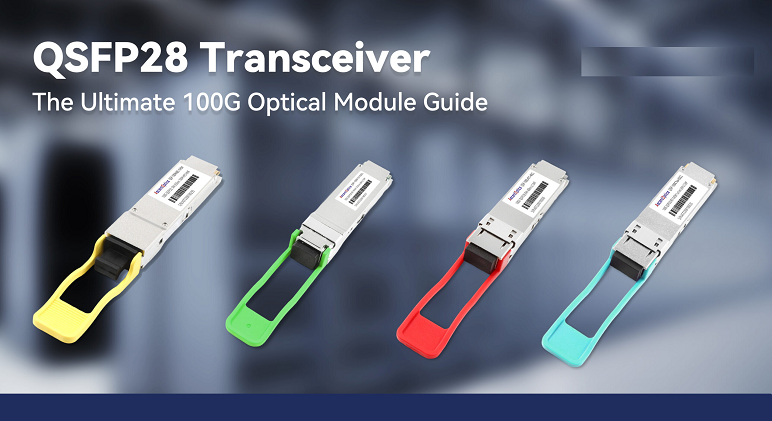
As data demands surge across industries—from hyperscale data centers to enterprise cloud networks—high-speed, short‑reach optical connectivity has become critical. Among the many 100G optical transceiver options, the 100G QSFP28 SR4 stands out for its scalability, efficiency, and cost‑effectiveness. This compact module combines mature optical technology with robust performance to help modern infrastructures handle the explosive growth of data traffic without compromising reliability.
What Is the QSFP28 SR4?
The QSFP28 SR4 (Quad Small Form-Factor Pluggable 28, Short Range 4‑lane) is a hot‑pluggable optical transceiver designed for 100‑Gigabit Ethernet applications over multimode fiber (MMF). “SR4” means the module uses four parallel transmit and four parallel receive optical channels, each operating at 25 Gbps, resulting in a total aggregate bandwidth of 100 Gbps.
It is built to fit the industry‑standard 100G QSFP28 form factor, identical in size to the popular 40G QSFP+ module, making it easy to upgrade existing network hardware. The SR4 operates at a wavelength of 850 nanometers and typically supports transmission distances of up to 100 meters using OM4 fiber, or 70 meters using OM3 fiber.
How the Module Works
Inside every QSFP28 SR4 module lies sophisticated optoelectronic technology that converts electrical input signals from a host device—such as a switch or network interface card—into optical signals transmitted through fiber.
- Transmit Side: Electrical data signals are modulated and fed into VCSELs (Vertical‑Cavity Surface‑Emitting Lasers). Each of the four lasers outputs at around 850 nm, transmitting four parallel 25 Gbps optical signals.
- Receive Side: The incoming optical signals from the fiber are detected by photodiodes (PIN detectors), which convert them back into electrical signals for processing by the host equipment.
This parallel architecture allows simultaneous high‑speed transmission and reception, minimizing latency and maximizing throughput in short‑reach environments.
Key Technical Specifications
| Parameter | Specification |
| Data Rate | 4×25 Gbps (aggregate 100 Gbps) |
| Wavelength | 850 nm |
| Fiber Type | MMF (OM3 / OM4 / OM5) |
| Connector | MPO‑12 / MTP® (8 fibers active: 4 Tx + 4 Rx) |
| Transmission Distance | 70 m (OM3), 100 m (OM4), 150 m (OM5) |
| Operating Temperature | 0 °C to 70 °C (commercial grade) |
| Typical Power Consumption | < 3.5 W |
| Standards Compliance | IEEE 802.3bm, SFF‑8665, MSA compatible |
These specs make the QSFP28 SR4 a go‑to choice for top‑of‑rack and leaf‑spine architectures, offering reliable, short‑range 100 G connectivity between switches or between switches and servers.
Technologies Enabling QSFP28 SR4
A few core technologies make the SR4 module both powerful and economical:
- VCSEL Technology
Vertical‑Cavity Surface‑Emitting Lasers have become the preferred light source for multimode transceivers due to their low cost, low power consumption, and efficient coupling with MMF. VCSEL arrays can be manufactured with high precision, making them ideal for scalable 25 G/100 G products.
- MPO/MTP® Connectors
To support four transmit and four receive channels, QSFP28 SR4 modules use a 12‑fiber MPO/MTP® connector, of which eight fibers carry active data signals. These connectors simplify high‑density cabling and support quick, tool‑less installation or replacement—important in dynamic data‑center environments.
- Multi‑Source Agreement (MSA)
The QSFP28 interface standard is defined by the SFF‑8636 and MSA agreements, ensuring that modules from different vendors remain interoperable across various network devices. This backward‑compatible design allows seamless integration with QSFP+ slots, offering flexibility for mixed 40G/100G environments.
Deployment Scenarios
The short‑reach performance of QSFP28 SR4 makes it the perfect solution for intra‑data‑center connections where cable distances are typically less than 100 meters. Common use cases include:
- Switch‑to‑switch interconnects within the same rack or row
- Server‑to‑leaf connections in leaf‑spine architectures
- Aggregation to core fabric links in enterprise networks
- High‑performance computing clusters, which rely on low‑latency fiber links
Its plug‑and‑play design allows network engineers to deploy or upgrade 100 G links quickly without changing the existing rack layout or power design.
Advantages of QSFP28 SR4
- Compact Form Factor: Maximizes port density—ideal for switches with many 100G ports.
- Low Power Draw: Typically consumes less than 3.5 watts, lowering operational costs.
- High Reliability: Proven VCSEL and MMF technology deliver stable optical links.
- Cost Efficiency: More affordable than single‑mode 100 G solutions (such as LR4 or CWDM4).
- Scalability: Supports configurations like 4×25 G breakout, enabling flexible network design.
- Widespread Ecosystem: Compatible with popular switch brands like Cisco, Arista, Juniper, Dell, and Mellanox.
Comparing SR4 with Other 100G Modules
| Module Type | Fiber Type | Wavelength | Max Distance | Connector | Ideal For |
| QSFP28 SR4 | MMF | 850 nm | 100 m (OM4) | MPO‑12 | Short‑reach intra‑data‑center links |
| QSFP28 LR4 | SMF | 1310 nm | 10 km | LC duplex | Long‑distance links between buildings |
| QSFP28 CWDM4 | SMF | 1271–1331 nm | 2 km | LC duplex | Medium‑distance connections |
| QSFP28 PSM4 | SMF | 1310 nm | 500 m | MPO‑12 | Parallel‑fiber single‑mode applications |
While single‑mode modules such as LR4 support longer distances, they come with higher component costs. SR4 remains the preferred choice where distance is short, but density and budget efficiency matter most.
Installation Tips and Best Practices
To ensure optimal performance from your QSFP28 SR4 modules:
- Use high‑quality multimode fibers (OM4 or OM5) with properly cleaned connectors.
- Maintain correct polarity for MPO/MTP® cabling (Type B polarity is standard).
- Avoid tight bends that can introduce signal loss.
- Ensure proper airflow around densely packed switches—heat management extends optical module life.
- Check interoperability with transceiver vendors certified for your switch brand.
Following these guidelines helps maintain signal integrity and extends component lifespan in high‑density deployments.
The Future of QSFP28 SR4 in Data Networking
Although newer 400G and 800G technologies are emerging, the QSFP28 SR4 continues to hold strong relevance. Many enterprise and cloud data centers still center their infrastructure on 100 GbE—it offers an excellent balance between cost, efficiency, and bandwidth. Furthermore, existing QSFP28 platforms can interoperate with next‑generation systems via breakout cables (for example, 400G QSFP‑DD → 4×100G QSFP28 links), ensuring longevity and upgrade flexibility.
The evolution of MMF standards such as OM5 and innovations in VCSEL designs promise even higher efficiency, extending the lifespan of SR4 technology well into the era of 200G and 400G migration.
Conclusion
The 100G QSFP28 SR4 optical transceiver represents a cornerstone of modern data‑center connectivity. Its mature, cost‑effective design provides exceptional performance for short‑reach applications without sacrificing energy efficiency or reliability. For organizations looking to build scalable, high‑performance, and future‑ready networks, the QSFP28 SR4 remains one of the smartest and most dependable choices on the market.