Introduction
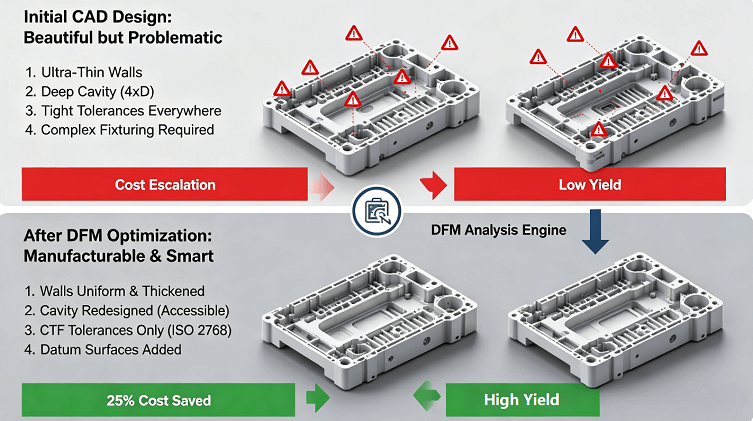
In the fierce competition of developing new hardware, engineers frequently encounter an unfortunate truth: a beautiful CAD model leads to inevitable cost escalation and low yield once it reaches manufacturing. Although online platforms such as Protolabs and Fictiv provide rapid quotations, they cannot compensate for a design that fails to account for manufacturability from the very beginning, resulting in high costs and delays before launch and decreased profitability. This situation arises because of a broken design-to-manufacturing process, which involves making decisions in isolation from the physical realities of the factory floor and its economics.
This paper proposes a solution for design-for-manufacturing challenges through a structured set of recommendations that will guide teams to avoid common mistakes. This process leverages six strategies based on principles of engineering excellence that allow engineers to save money and predict successful project completion.
Why Is Design for Manufacturing (DFM) Essential for Industrial Design Optimization in the Digital Age?
Design for Manufacturing (DFM) stands out as the indispensable factor in ensuring that an innovative idea can be successfully manufactured as an item. It represents the intelligent incorporation of production expertise from the very beginning of the design process, thus making industrial design optimization both manufacturable and efficient. Without DFM, no matter how sophisticated the digital instruments and platforms are, they will simply be channels for costly mistakes.
Bridging the Costly “Design to Production” Gap
What Is DFM? Fundamentally, DFM means an approach that is ahead of one’s time and involves several disciplines/areas of expertise. It assumes/designs/designers are working together/manufacturing engineers and designers collaborate from the product’s first idea to assure that it can be manufactured with the existing methods, within the budget, and satisfying the quality standards. The economic impact is/is quite large because even 80% of the final cost of an item is decided in the early design stages. DFM means removing cost-increasing features like very tight tolerances, unusual hole sizes, or complex internal shapes.
Past Automated Quoting Systems: The Limitations of Platforms’ Logic
The automated systems for pricing provided by online platforms such as Hubs or Wayken are superb in terms of estimating costs for a particular design. Nevertheless, such platforms cannot help question whether this particular design is actually manufacturable. The platform just uses the inputted data and does some calculations with the assumptions that come to mind. A good DFM approach will always pose questions such as whether “this deep pocket can be cut with a typical set of tools.” “Is this wall thickness feasible for the selected material?” This will not lead to the situation known as “garbage in, gospel out.”
DFM as an Enabler for Innovation and Rapid Prototyping
Instead of being a barrier to innovation, DFM actually facilitates greater innovation through its provision of a realistic platform for designing parts. Once a designer appreciates the limits that come with using various manufacturing techniques such as CNC machining, injection molding, and sheet metal fabrication, he or she becomes able to innovate designs that are practical and feasible at the same time. Doing this eliminates the endless process of revisions that may take many weeks, thus speeding up product development.
How to Apply DFM Principles in Enhancing CNC Machining Efficiency?
The use of DFM principles in CNC machining is dictated by a number of guidelines. They are not arbitrary rules, but rather the distilled experience of physics, material behavior, and limitations of the machines. Understanding and implementing the DFM principles enables one to design products that are easily programmed, fixtured, and machined more efficiently, reducing costs and lead times in the process.
Designing around the Tool: Radius, Cavity, and Wall Thickness
The cutting tool dictates most of the rules. For example, one should design internal corners with radius bigger than that of the cutting tool to ensure smooth milling; avoid designing parts with cavities higher than four times the width to facilitate the chip removal process; and use a uniform wall thickness. Following the above guidelines will significantly reduce the number of tools needed to manufacture the part, thus, increasing CNC machining efficiency.
Tolerance Stack-Up, and the “Critical vs. Standard” Mindset
As one of the basic principles in DFM guidelines, the smart selection of tolerances cannot be overlooked. Application of an equal ±0.025mm tolerance across all dimensions is ineffective and costly. The engineering excellence philosophy requires the identification of Critical To Function (CTF) dimensions, and applying strict tolerances just to those dimensions; everything else receives commercial tolerances. This process, which relies on standards such as ISO 2768, simplifies inspection, improves the yield rate in the process, and lowers machining cost by up to 15 percent with no impact on product performance.
Facilitating Fixturing, and Limiting Setups
If the workpiece can be held very easily during the machining process, the production might be very cheap. DFM rules say that soft jaws that can be machined, fixturing tabs that can be machined, and datum surfaces should be part of the design of the piece, if at all possible. Besides, it is better for the piece to be manufactured in very few set-ups; the best is a single one using 3-axis or 5-axis machines. When selecting partners, besides cooperating with experienced and online CNC machining suppliers, one should also look for those that offer useful feedback on fixturing and setups.
What are the Best Practices for DFM in Reducing Costs of Production?
DFM best practices refer to the use of certain guidelines to specifically address and tackle the three critical factors that influence the costs of manufacturing parts: the material used, machining time, and labor. Through such strategic designs, engineers can make significant cost savings without the need for value engineering or negotiating prices with suppliers.
- Strategic Material Selection and Utilization: Using a right material as well as making good use of the material is critical in terms of achieving significant cost reductions. A best practice when applying DFM involves the selection of a commonly available and standard grade material (i.e., 6061-T6 aluminum as opposed to a specialized alloy) that will suffice in satisfying the performance requirements. In addition, the design should be such that the use of the standard sheet or bar stock is optimized. A small shift in position or even the design of the contour can lead to up to a 10-20% reduction in scrap.
- Reducing Non-Value Added Machining Time: Every moment of time spent by a machine cutting through air, producing an undesired surface, or performing a secondary set up adds costs. Such best practices as reducing number of tool changes through consolidation of features, designing symmetric parts that may be duplicated within CAM, and reducing cosmetic machining are essential to minimize such machining. Such practices that make CNC machining process efficient, not to mention less costly, are the ones that separate good from bad – designs optimized for production and not just possible to produce.
- Standardizing Features and Designing for Processes’ Strengths: Unique items are costly, as customization is expensive. It is important to design standard hole diameters, threads, and fastener sizes to utilize common speeds. Moreover, best practice #3 suggests that designers must know what features are better done with a specific process and design according to that process. In case a particular feature can be created more efficiently with CNC turning than milling, it makes sense to avoid designing otherwise. MIT OpenCourseWare offers great insight into different production techniques’ advantages and disadvantages.
Why Do OEM Engineers Need to Hire DFM Consulting Experts for Their DFM Analysis?
Although internal departments are well-informed about the product, they might not be sufficiently aware of different manufacturing processes that could reveal latent producibility problems. The involvement of DFM consultation professionals in performing DFM analysis is the best solution here since it will provide objective and risky-free advice. This synergy allows obtaining information beyond the scope of the platform recommendations, thus converting manufacturing obstacles into manufacturable products.
Getting Industry-Independent and Process-Multiplied Perspective
When working with a number of projects from various industries, a professional supplier of DFM services accumulates an extensive base of known failures and effective solutions. Such company would know about possible stresses in the structure of a medical device bracket as it saw the same situation in the case of automotive devices. It can use the concept of snap-fit that was previously used for consumer products while designing an enclosure for the industrial purposes.
More In-depth Analysis Than Automated Feedback
Automated manufacturability feedback from platforms like Protolabs may be helpful, but the information is generic and generated through an algorithm. The DFM consultation professional offers relevant context and partnership. They do not merely point out a thin wall, but they explain the physics behind heat generation that leads to distortion because of the manufacturing process, providing possible solutions such as ribbing or different materials. The professional gives a comprehensive, priority-ordered report, including quantification of the cost-effectiveness of their advice.
Creating the Base for Scalable, Reliable Manufacturing
When the design is intended to go on sale for high regulation or high volume, the risk becomes significant. A DFM consultant experienced in standards such as IATF 16949 or AS9100D will incorporate preventative quality in the design. They assist with developing the Failure Mode and Effects Analysis (FMEA) for the design feature. This is essential for ensuring that the design is not only manufacturable but also reliably manufacturable at scale, creating risk-based design assurance and thus a necessary strategic decision.
Ensuring Engineering Excellence Through Advanced Manufacturing Knowledge
Achieving engineering excellence involves much more than running machinery. It entails systematic integration of theoretical concepts with actual production practices. This can be achieved through use of certified quality management systems and knowledge gained from across industries in form of advanced manufacturing insights. This will ensure that all projects have access to a body of experience developed throughout the years as well as a prevention-oriented attitude.
System Based on Best Practice Quality Systems
Operation within strict standards such as IATF 16949 (automotive) and AS9100D (aerospace) gives a framework for achieving excellence. Such standards go beyond merely certifying products but constitute an effective management system where processes such as Advanced Product Quality Planning (APQP) must be implemented. This results in design for manufacturing (DFM) becoming an obligatory and documented stage of the process.
Insightful DFM Recommendations Based on Extensive Experience
With thousands of complex components manufactured over time, valuable expertise can be developed. Consequently, engineers will be able to provide not only general advice but specific recommendations based on the analysis of their experience. Referring to the history of previous projects (like the effect of certain features on the lifespan of cutting tools or yield) makes it possible to increase the objectivity of DFM recommendations.
DFM as a Partnership Based on Collaboration
A strong collaborative spirit is another trait of this approach. Engineers participate as an integral part of the design team and use tools such as 3D PDF markup and online review meetings through which they can explain in detail why something needs to be changed. This way, the customer gains not only recommendations but the understanding of why they were made. This kind of collaboration is crucial in establishing a partnership between companies. For an overview of such an integrated approach to DFM, one can refer to the guide on Design for Manufacturing for CNC machining.
How does DFM in product design enable the efficiency of smart factories?
DFM principles in product design are the necessary foundation for harnessing the true capabilities of smart factories. A “smart” machine is unable to correct flaws in poor part design — rather, it merely produces flawed parts more quickly. Through manufacturing-oriented design, engineers produce a clear and effective data model and process — a critical combination required for automation, monitoring, and predictive analysis to fulfill their intended role.
- Ensuring Clean Digital Thread for Seamless Automation: Efficiency in a smart factory system depends upon a perfect digital thread — from CAD design through CAM programming to machine operation. Parts designed according to the DFM principles create clean, clear geometries and tolerance strategies in CAD, enabling fully automated and error-proof CAM programming as well as MES integration. Flawed designs, on the other hand, disrupt the digital thread and necessitate manual effort, re-programming, and ultimately ruin automation efficiency.
- Facilitating Predictive Process Control and Zero Defect Objectives: A good design for a product would be one whose process windows would be very stable. This would mean that the machining parameters, including speed, feed rate, and depth of cut, are optimal and consistent. In a smart manufacturing facility, there would be the use of sensors for continuous monitoring of the processes. Because of the stable nature of the design, any deviation in measurements like vibration and temperature would have some significant meaning, making it impossible for there to be defects.
- Enabling the Transition to a Data-driven Quality and Continuous Improvement Approach: Current quality management systems are transitioning from an inspection-based approach to a more data-based approach. Product design through DFM allows this approach since the parts are easy to measure, and the CTQ features are well-defined. The use of an intelligent factory enables automatic collection of probe data during manufacture and CMM data after manufacture. For a well-designed DFM part, this data demonstrates stable process capability. This is evidence of quality and enables continuous improvement since manufacturing data is used in establishing DFM guidelines. This is consistent with initiatives such as NIST.
Conclusion
Achieving optimal manufacturing results is impossible without optimal design. Using the principles of Design for Manufacturing (DFM) throughout the design process and following the methodology of excellence in engineering will allow your company to reinvent the development process. In addition to delivering the desired result in the form of dramatic cost savings and reduced time-to-market, implementing DFM will lay the groundwork for innovation, quality, and resilience in the supply chain. In the competitive environment of today, becoming proficient at DFM is more than a technical skill — it is an essential strategic competency that helps bring innovative designs to market.
FAQs
Q1: How do I confirm my CNC machining supplier’s DFM capabilities without an on-site inspection?
A: Request a sample DFM report from your supplier based on a prior project. A reliable CNC machining supplier’s report will typically feature specific suggestions accompanied by illustrations or photos. Have a technical chat on phone through which you will be able to evaluate the supplier’s expertise technically with respect to tolerances, material considerations and tooling.
Q2: What is the importance of DFM Best Practices in minimizing costs associated with complex part fabrication?
A: The adoption of DFM Best Practices helps to eliminate the principal sources of unnecessary expenses, including excessive processing time, expensive tooling, and complex fixturing requirements. These practices allow for the optimization of features, wall thicknesses, and setups, streamlining the CNC machining process and reducing manufacturing costs while improving lead time and reliability.
Q3: When is it wise to consider outsourcing DFM services?
A: It is sensible to engage in outsourced DFM analysis for complex, high-risk applications (such as medical devices or aerospace hardware), lack of manufacturing experience within your company, and novel manufacturing processes. An outsourced DFM service offers a comprehensive, unbiased assessment that may help identify potential risks and minimize them before transitioning into mass production.
Q4: Is DFM in Product Design restricting the creativity of a designer?
- No, because DFM helps with the application of creativity through an achievable reality framework. The knowledge of manufacturing realities makes it possible for the design team to create something innovative that is both practical and cost-effective in terms of production.
Q5: In what way do the leading suppliers make use of the Smart Factory Efficiency to improve their DFM service offering?
A. The leading suppliers leverage the smart factory efficiency data (telemetry and in-process inspection), thereby making it possible for them to give out recommendations that take into account practical realities and not assumptions alone.